
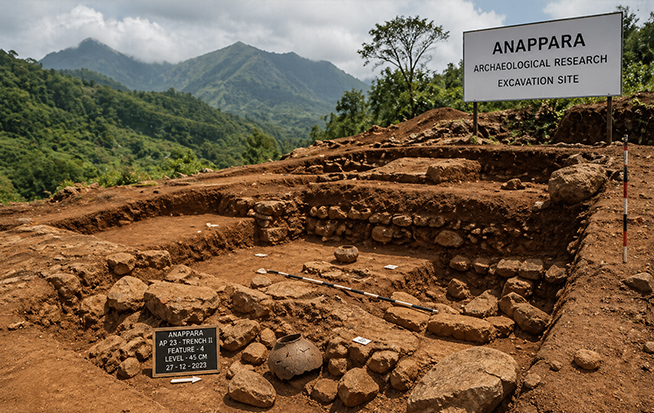
The archaeological landscape of Kerala is renowned for its rich Iron Age, Early Historic, and megalithic traditions, marked by burial sites scattered across the region. Although scholars have studied many of these burials since the early nineteenth century, habitation sites have remained far less visible.
Environmental challenges such as heavy rainfall, dense forest cover, soil erosion, seasonal flooding, the use of perishable materials in ancient settlements and lack of systematic research largely account for this disparity. Against this backdrop, the site of Anappara in Idukki's high ranges provides crucial evidence for settlement patterns alongside burial traditions.
Anappara (9°42'50.87"N, 77°11'27.83"E) is situated in Anakkara village, Udumbanchola taluk of Idukki district, Kerala, close to the Tamil Nadu border at an elevation of about 1140 metres.
Surface surveys uncovered pottery including Red Ware, Black Ware, and Black and Red Ware, along with iron implements indicating production activities. The site spans several localities, with the eastern slope serving as the primary habitation zone.
Agricultural terracing has altered this area, exposing cultural materials in soil sections. Nearby features, a cave-like formation and megalithic burials such as dolmens, cists, menhirs, and urns reveal a multifaceted cultural landscape that integrates settlement and funerary practices.
The excavation revealed two primary cultural phases at Anappara. The earliest is a microlithic occupation identified within red soil layers resting directly over the bedrock, where microlithic chips were recovered from the lower levels of a modern construction cutting and correlated stratigraphically with the excavated trenches.
The second phase corresponds to a Late Iron Age–Early Historic occupation, characterised by ceramic assemblages, iron objects, beads and architectural features such as stone terraces. Radiocarbon dates from Layer 3 in AP24 II (Sample 147) and AP24 III (Sample 155) yield calibrated ranges of 564 - 401 cal BCE (mid-point 483 BCE) and 478–357 cal BCE (mid-point 395 BCE) respectively, indicating that the main early historic occupation began by at least the 5th century BCE and continued until around the 3rd century CE on the basis of material culture.
This Anappara research fills a critical gap in Kerala's archaeology: our limited grasp of highland habitation sites. Despite Idukkis archaeological promise, its forested terrain and active agriculture have left it underexplored. The study reconstructs occupation patterns, settlement organization, and economic activities in the region.
Given its strategic position and prominence, Anappara likely served as a nodal point or regional market along early historic trade routes that connected western coastal hubs like Muziris to eastern Tamil Nadu regions.
Systematic excavations in four trenches within the main habitation area advanced these goals. The analysis integrates stratigraphy, ceramic typology, and scientific techniques like radiocarbon dating and sediment studies to define the site's cultural sequence.
It emphasizes material remains such as pottery, faunal evidence, and iron artifacts, that hint at craft activities and metalworking. This multidisciplinary effort illuminates iron age/early historic lifeways in Kerala's highlands and their connections to broader trade and cultural networks.